Statement of intent
Series inspired by the Baghera Universe
In the Baghera Universe, fiction imagines a future where survivors of an ecological collapse live secluded in a Megalo-Paul governed by an artificial intelligence named Paul Lia. In this city cut off from all relationship with the living, nature has become the enemy, and everything that comes from it is rare, regulated, sometimes forbidden. The book, in particular, becomes a singular artifact: each inhabitant can possess only one — sometimes, a single page. It is no longer just a narrative to read, but an object carrying a narrative in itself, charged with history, value, memory. A fiction within the fiction.
It is from this principle — this symbolic and political constraint inscribed in the Baghera universe — that I initiated this series, inspired by my imaginary universe. I took my own novels from this universe, and decided to apply to them the laws of the world they describe. Each copy then becomes a unique artwork, transformed, rewritten by gesture, marked by a personal trace. Each book is a reincarnated fragment, a singular edition, carrying within it an intimate link with my own life.
This series operates a reversal: it brings fiction into reality, it materializes a speculative universe in the tangible world. The novel is no longer a simple narrative medium, but an autonomous narrative object, inhabited, carrying a memory. It becomes both relic and manifesto, discreet sculpture and transmission medium.
In the continuity of my practice — where the artwork often exists through its reinvention, through its survival in new forms — these books embody an attempt at immortality. They live in our world as they would have lived in Baghera's: precarious, essential, carriers of singularity.
Each copy is a survival. A memory in motion.
"Reincarnations" Series
Each copy of this series is a unique artwork, embodying an autonomous narrative fragment from the real and fictional world. The book becomes trace, memory, living object.
1. Humid Novel
Novel that absorbed humidity during its storage at the Ouest Hurlant 2025 booth. It retained, for a time, a slight smell of galette-saucisse.
📷 Photo: our booth at Ouest Hurlant
📹 Video: the galette-saucisse consumed at the booth
📹 Video: the galette-saucisse consumed at the booth
2. Municipal Library Novel
Novels deposited at the 9th arrondissement library in Paris, refused, then recovered. Rejected by the institution, adopted by the artwork.
📹 Video: the attempted deposit at the library
3. Novel Read by One of Its Authors
For GDPR compliance reasons, the author's identity cannot be revealed.
📷 Photo: the two authors reading their novels
🎧 Audio: an excerpt from the novel read by the two authors, their voices superimposed
🎧 Audio: an excerpt from the novel read by the two authors, their voices superimposed
4. Endless Novel
The last page has been torn out. Assumed incomplete work; the price has been adjusted. Two copies.
🎧 Audio: the last page tearing
The missing page has been sealed in an envelope and cannot under any circumstances be opened. If it is opened, then the artwork no longer exists.
5. Sleeping Pill / Bed Novel
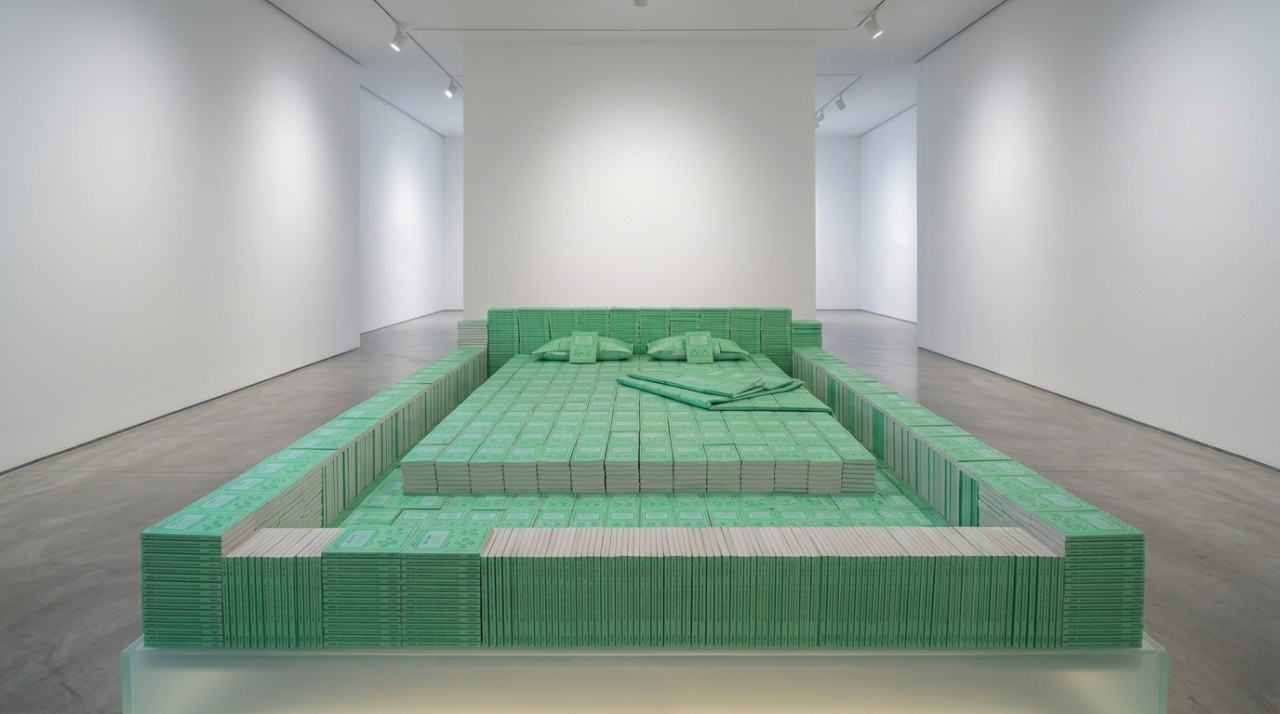
These novels were extracted from a book-mattress on which we slept for several months. Reading by impregnation.
📹 Video: the book-mattress
6. Novel Page
In the Megalo-Paul, each citizen can possess only one page of a book. These pages bear traces of exchanges, annotations, losses. A story within a story.
📹 Video: tearing one by one the pages from volumes 1 and 2
📝 Note: "The book was anesthetized before the operation. It did not suffer."
📝 Note: "The book was anesthetized before the operation. It did not suffer."
Each page is exhibited in order, one after the other, in a line, they are all, like the books, frozen in a plexiglass plate. They have no annotations or titles. Their individual stories are not shared. They are fragments of the future, directly imported from the Megalo-Paul (Baghera Universe).
Conceptual development: Some pages have been loaned to individuals, without particular instructions. Their simple presence in a daily life is enough to transmit a story to them. Upon their return, these pages are exhibited with some data: name, profession, loan period, and a title summarizing what they went through. Each fragment then becomes the site of a double memory: that of the fictional world from which it comes, and that of the reality it touched.
Instructions for Presenting the "Reincarnations" Series
Each copy of the series is presented frozen in a frozen bag, like an archaeological fragment from the future. This glass enclosure aims to suspend the object in time, to protect its story while making it visible, almost fossil-like.
Each artwork is accompanied by a narrative element (photo, video, sound, text), which documents or replays the event that transformed the object. This media acts as a witness, a peripheral memory, fictional proof.
The whole constitutes an embodied archive: a material memory of imaginary worlds.
"Reincarnations" Series - Visual Fragments
Performance - A Fragment for Everyone
"Reincarnations" Series
When I present my novels in public space, I often notice one thing: visitors stop, look, linger. They receive something from the artwork — an emotion, an idea, a projection. But very few cross the threshold of acquisition. Yet, even without leaving with the object, they leave with a fragment.
This performance materializes this phenomenon. Sitting behind a booth — a faithful reproduction of those at my conventions — I tear, one by one, the pages from my novels. Each page is given to a spectator.
This gesture is not destruction, but transmission. It gives body to an exchange already at work: what the gaze takes, what the imagination captures, what attention carries away. Each page becomes the physical witness of this fleeting but real connection. It embodies a shard of the BAGHERA universe, a crumb of narrative, torn from continuity to anchor itself in the present.
It's also a direct echo of the rules of the Baghera Universe: at a certain period in its history, the inhabitants of the Megalo-Paul are entitled to only one page of a book, which they exchange. Here, I distribute. This fragment of paper becomes a passage between worlds — a point of contact between fiction and reality, between the artwork and the one who receives it. A shared artwork, fragmentary, but embodied.