The images presented here stem from research and exploration. They do not constitute the realization of the work; in my practice, the proposal itself serves as the work.
Artist's Statement
The International Bureau of Conceptual Certification is an institution for legitimizing the immaterial. It certifies the existence of concepts, ideas, and unrealized projects without requiring their prior materialization. By issuing an official certificate for any submitted proposal, the IBCC asserts a radical position: the idea is enough.
This work responds to a dominant logic that only recognizes value in what is executed, produced, visible. It proposes a reversal: what if a concept's existence didn't depend on its realization, but on its certification? What if legitimacy came not from material proof, but from an act of authentication?
The IBCC presents itself as a serious institution, equipped with a rigorous protocol, a professional website, bureaucratic language, and numbered and stamped certificates. It functions in reality: any person — human, artificial, fictional, or otherwise — can submit a concept and receive a certificate attesting to its existence. The service is paid (€42). Each certification generates two copies of the digital certificate: one for the applicant, one for the IBCC archive.
The institution exists in a zone of fertile ambiguity: it is simultaneously a functional service and an institutional fiction, a tool of legitimization and an artistic performance. This porosity between real and imaginary is at the heart of my practice: making fiction cross into the tangible world, without immediately revealing the nature of the operation.
Performative dimension
The IBCC is not just a system — it's a performance of authority. By presenting itself as an official certification body, it questions the mechanisms of legitimization: who has the power to say what exists or not? What makes something "valid" — a stamp, a signature, a registration?
The work relies on a strategy of discreet infiltration. The website, language, and certificates adopt institutional codes without apparent irony. A few absurd details — subtly integrated into the form or legal notices — nevertheless betray the fiction for those who read carefully. This ambiguity allows the work to exist on multiple levels simultaneously:
• For some: a real certification service
• For others: a bureaucratic parody
• For others still: a conceptual work on validation and existence
• For the art world: an institutional critique of authority and legitimization
The archive as collective work
Each certificate issued feeds an archive that becomes, over time, a cartography of the unrealized imaginary. This archive is not my personal work — it is generated by the concepts of others. My role is limited to creating the protocol and executing it. The archive thus becomes a collaborative work, composed of fragments of individual universes certified by the same fictional authority.
This archive can be exhibited, visualized, consulted — tangible proof of a parallel world where ideas exist independently of their materialization.
Sale and transfer of the work
The work can be acquired by a collector according to the following terms:
What is sold:
• The complete protocol (detailed technical manual)
• The existing archive at the time of sale
• All future revenues generated by upcoming certifications
What changes after the sale:
• The collector becomes owner of the IBCC
• They receive 100% of revenues from future certifications
• The system continues to function according to the established protocol
Who executes the protocol after the sale: The technical manual is sufficiently precise to allow any person (or entity) to execute it. The collector can:
• Commission me to continue the execution
• Delegate to someone else
• Execute it themselves
• Leave the system dormant
The collector can also resell the work. The new owner inherits the same rights and revenues.
Conditions of realization
This work exists through its proposal. Its realization is not necessary for its conceptual existence.
If there is realization, it can be:
• Partial: generation of a few certificates as documentation of the work
• Complete: activation of the system in its entirety (website, archive, permanent service)
A detailed technical manual accompanies this artist's statement. It contains:
• Website specifications
• Certificate design
• Step-by-step certification protocol
• Archive management instructions
• Transfer conditions to the collector
• All elements necessary for activating the system
Documentation elements
If the work is activated (partially or completely), documentation may include:
• Website screenshots
• Examples of issued certificates
• Archive visualizations
• Recordings of certification requests
• Testimonials from people who had their concepts certified
The International Bureau of Conceptual Certification proposes a simple but radical gesture: recognizing that the idea, in itself, deserves to exist. By creating the infrastructure that was missing for this recognition, the work materializes a philosophical position on the value of the immaterial. It becomes a space where the unrealized imaginary finally finds its legitimacy — stamped, numbered, archived.
The images presented here stem from research and exploration. They do not constitute the realization of the work; in my practice, the proposal itself serves as the work.

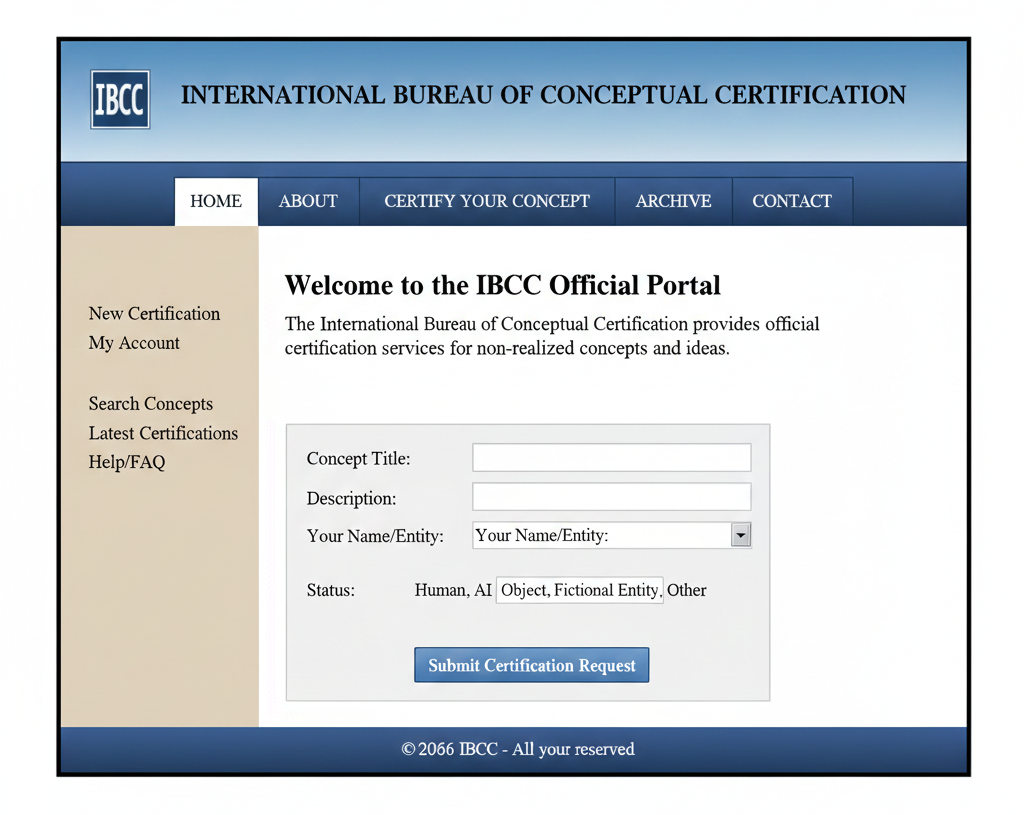
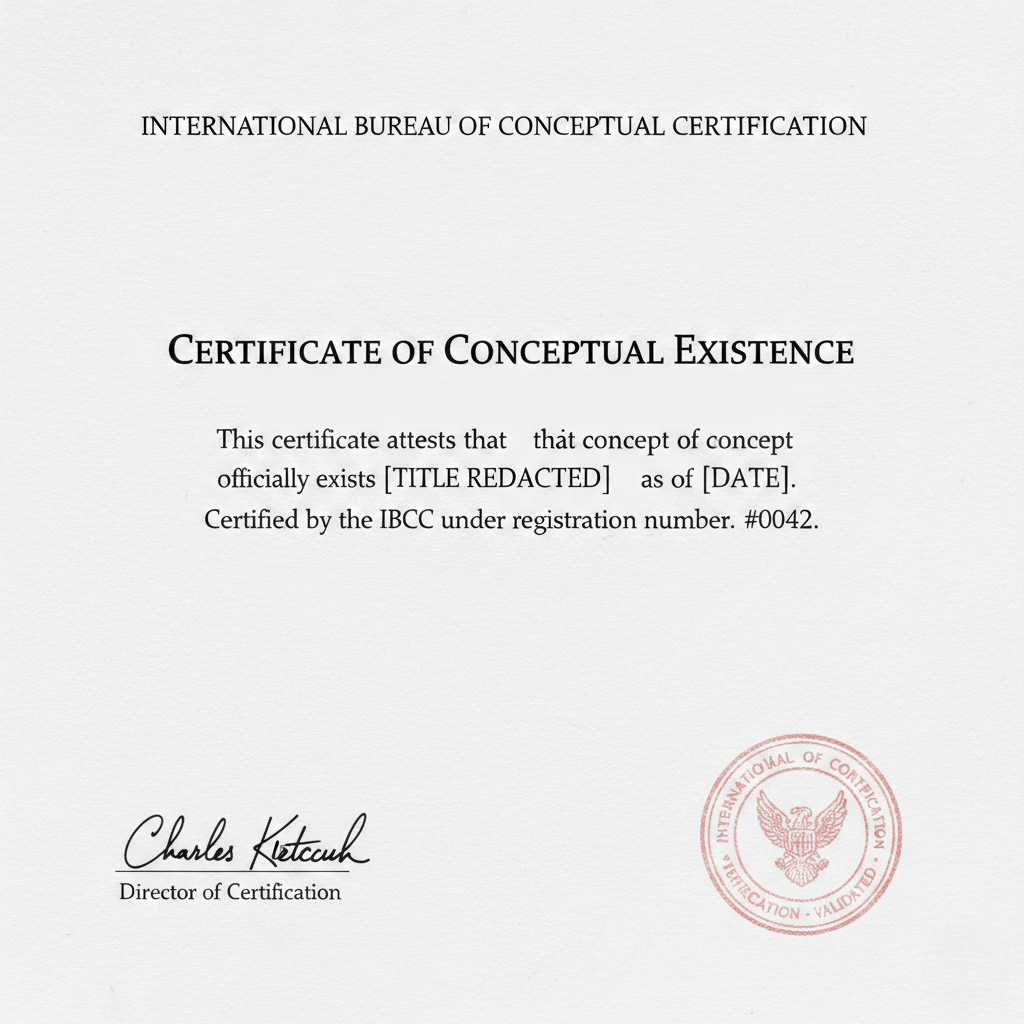
The images presented here stem from research and exploration. They do not constitute the realization of the work; in my practice, the proposal itself serves as the work.