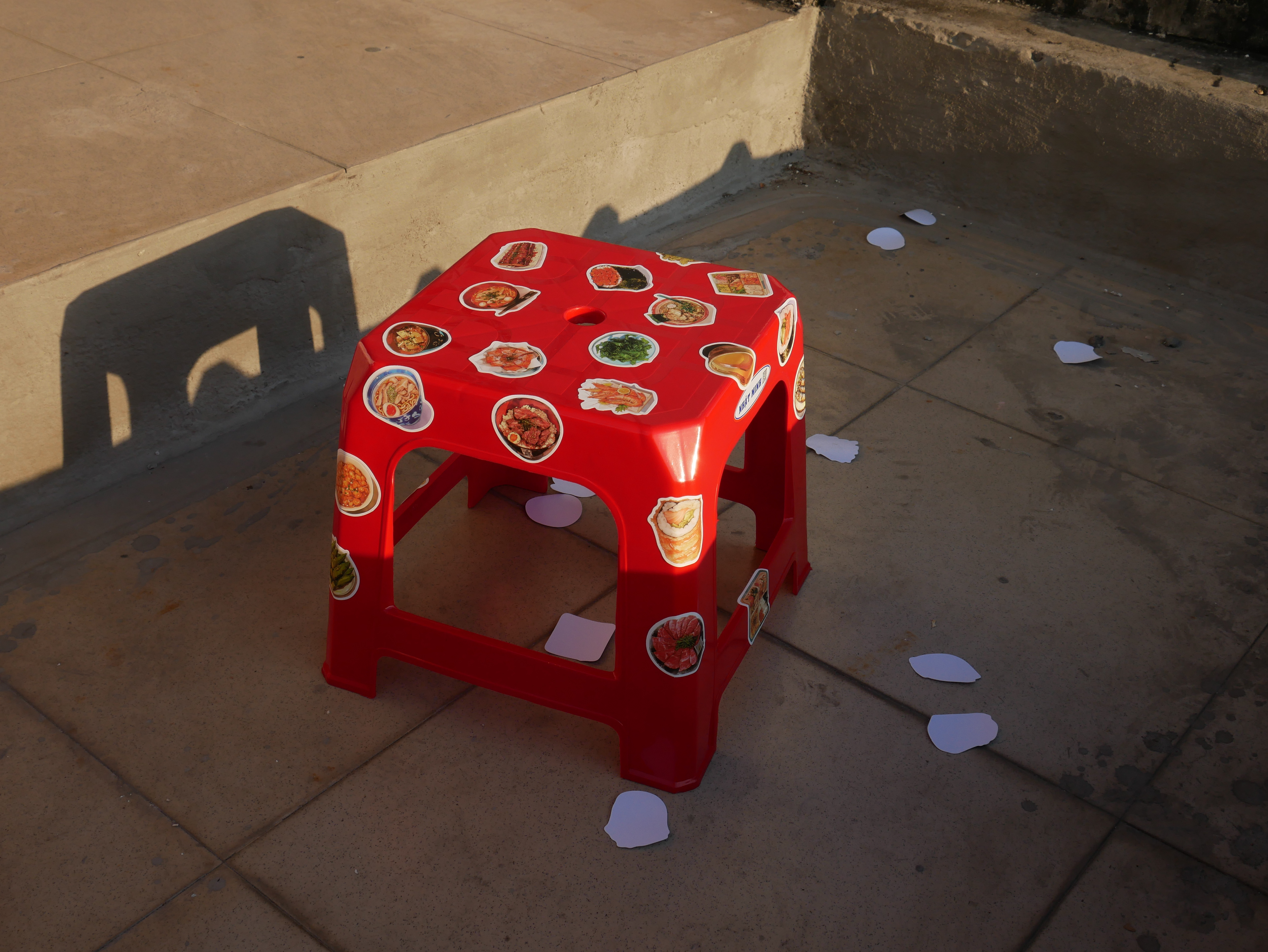
The images presented here stem from research and exploration. They do not constitute the realization of the work; in my practice, the proposal itself serves as the work.
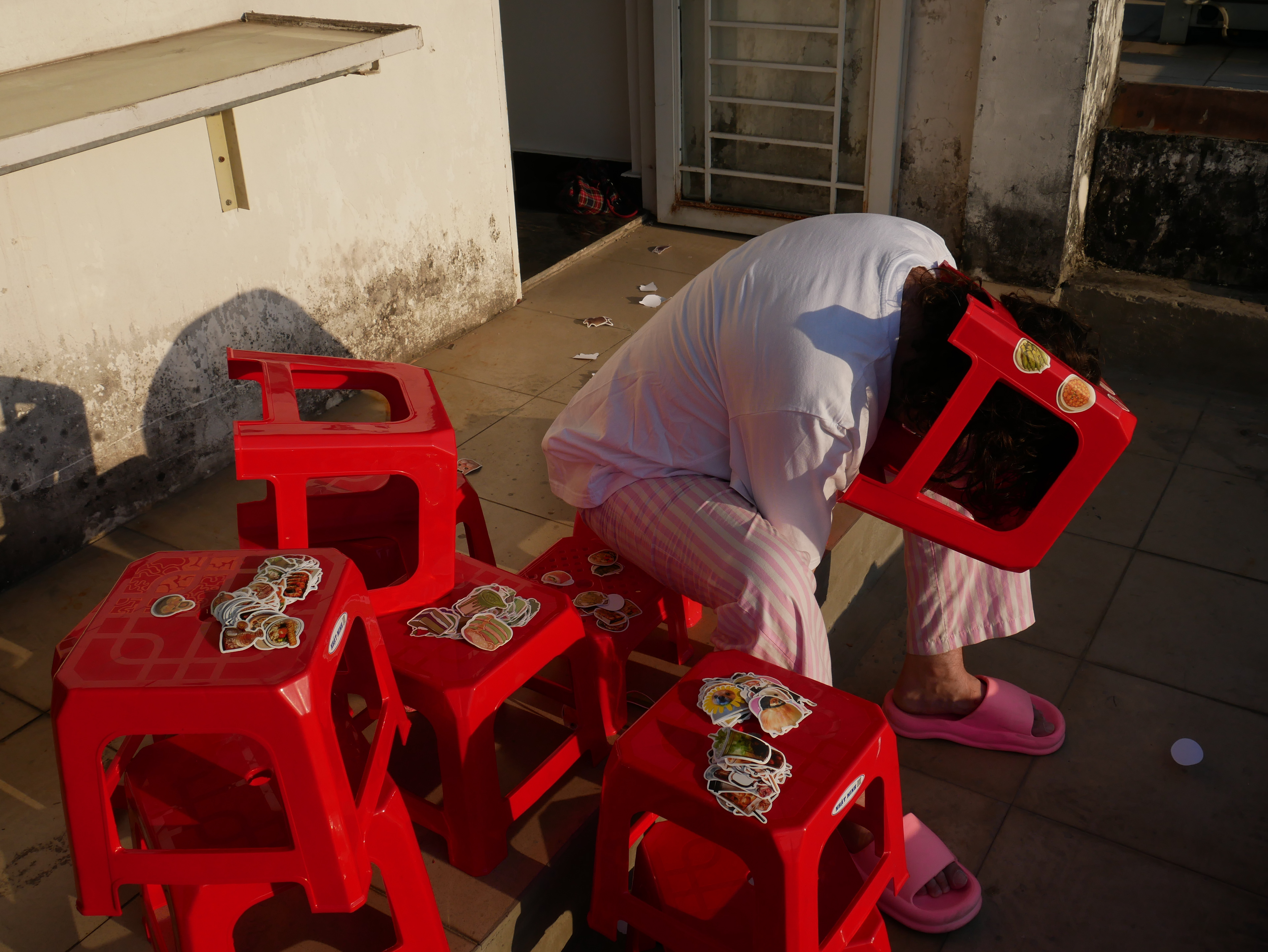
The images presented here stem from research and exploration. They do not constitute the realization of the work; in my practice, the proposal itself serves as the work.
Statement of Intent
The Vietnamese red plastic stool is everywhere. In the alleys of Saigon, on terraces, at market corners, in front of houses. A quintessentially democratic object, it crosses social classes without distinction. Mass-produced by the thousands, anonymous, interchangeable, it embodies both industrial mass production and a form of fluid circulation. No one truly owns it: it circulates, gets lent out, gets lost, comes back.
Ghế Đỏ Protocol takes this iconic object as raw material for a mechanical production protocol. Buried at the center of a mountain of virgin stools and customization tools, I become an executing system. I mass-produce unique objects, without aesthetic intention, following an industrial rhythm. Each stool is transformed by an automatic, random, constrained gesture. Sticking a sticker, that physical click, becomes the minimal gesture of this mechanical production. Randomness replaces choice, cadence replaces reflection.
The work interrogates this blurred boundary between human and system. Where does artistic intention begin when the gesture empties itself of consciousness? Can we distinguish human output from algorithmic output when both follow a strict protocol? Does the artist executing mechanically remain a creator, or does he become a medium, a simple production interface?
The process is filmed in continuous overhead shot. Surveillance view, foreman view, algorithm view. My face, my expressions are not visible. I become form, movement, function. The camera records the protocol, documents the execution, certifies that the rules have been followed. It's an objective, dehumanized memory, like that of an industrial security camera.
Spectators can acquire these stools via QR code. Dehumanized payment, transaction without visual contact. The price itself is randomly generated with each scan: even value escapes human decision. Once paid, I slide the stool to the ground without stopping. The buyer leaves with documentary trace of the protocol, not with the work itself. The work is the system. The stools are only its outputs.
New virgin stools are brought to me. The loop never stops. Continuous production, immediate consumption, endless cycle. I cannot leave the mountain. Productivist Sisyphus, worker-artist, human generator.
This work questions our contemporary relationship to production, to the unique, to the personalized. In a world saturated with "mass customization," each stool becomes different without having been truly chosen. The illusion of uniqueness produced industrially. The human transformed into a diversity machine. And somewhere, in this gesture repeated to exhaustion, a question persists: what remains human in a system that functions like an algorithm?
Certificate
Ghế Đỏ Protocol is not necessarily intended to be realized. The work exists primarily as a protocol, as a system of rules defining a mechanical production process.
This certificate attests to the authenticity of the conceptual work Ghế Đỏ Protocol created by Charles Ketchup. The work in its essential form is constituted by the protocol itself, as described in the instructions below.
Each execution of the protocol produces documentary elements that may include: a live performance, a continuous overhead video, photographs of the setup, an archive of transactions, and customized stools. These elements are not the work itself, but its material traces, its physical manifestations, its archival fragments.
The work can be acquired, executed or not by its acquirer. Whether it remains potential or takes form, it already engages a reflection on production systems, the dissolution of artistic intention, and the boundary between human and machine.
Execution can only be performed by Charles Ketchup and will be at the collector's expense.
Instructions for Use
Execution Protocol
1. Spatial Installation
The performer is installed at the center of a delimited space. Around him are arranged: • A mountain of virgin Vietnamese red plastic stools (ghế đỏ) 23.5 x 23.5 x H 26 cm. The quantity doesn't matter but must reflect the intent. • Stickers scattered within reach (see "Tool Selection" section below) • A purchase order visibly displayed indicating the number of units to produce and progress status. A purchase order template is provided with the work, it must be printed, filled out and signed by the collector (the client) and the artist (Charles Ketchup). It defines the performance execution.
The performer never leaves the center. He does not exit the mountain of stools. If objects fall during his movements, he continues without picking them up.
2. Tool Selection
Single material: Stickers
• Approximately 50 different stickers, maximum diversity of motifs (animals, fruits, symbols, texts, holographic, etc.) per stool
• At least 30% of stickers specific to the local geographical context • Available scattered around the performer, within reach
• Sufficient quantity to cover production needs
• The executor selects according to local context, available budget and material availability
Selection rule during performance:
• Totally random selection: the performer grabs without looking
• No conscious aesthetic choice
• Immediate application, without premeditated composition
3. Production Rules
• The number of units to produce is defined for each execution (example: 100 units)
• No fixed duration per stool: the rhythm must be industrial, "assembly line," without prolonged downtime
• Sticker selection is random: the performer grabs what is within reach without looking precisely at what, without prior aesthetic reflection
• Each gesture is final: no going back, no correction. Like an AI, "when it's done, it's done"
• The performer watches his work during execution, but does not seek to produce an intentional aesthetic result
• The objective is an "industrial" rendering: as neat as possible within the limits of technical skills and imposed rhythm
4. Sales System
• Stools are available for purchase via QR code only, and only during the performance.
• If stools are not sold, they will go into the Archive documentation and can no longer be sold. • The QR code leads to a web page/interface that generates a random price with each scan (range to be defined according to local context, example: between X and Y VND)
• Once payment is made, the performer slides the customized stool on the ground toward the buyer, without eye contact, without interrupting production
• The buyer leaves immediately with the stool if desired
• Collected funds are considered as the sale of documentary traces, not artworks in the traditional sense, they are not authenticated by the artist.
5. Production Loop
• New virgin stools are regularly brought to the performer to maintain the mountain
• Production continues until the number defined in the purchase order is reached
• The performance can be repeated according to other executions of the protocol
6. Mandatory Documentation
• A fixed overhead camera films the performance continuously
• This video captures the entire process: overview, movement of the performer buried in the mountain of stools, repetitive gestures
• The overhead shot dehumanizes the gesture: the face is not visible in detail, the performer becomes form, system, function
• This video constitutes the main documentation of the conceptual work and will join the archives.
Optional complementary documentation: photographs of the setup, archive of transactions (number, price, time), ambient audio recording.
All archives can be used for future exhibitions of the work.
Purchase Order (template)
The following purchase order must be visibly displayed throughout the performance:
──────────────────────────────────────────────────────────────────────────────── PURCHASE ORDER NO. [XXX]
────────────────────────────────────────────────────────────────────────────────
CLIENT: [Institution/venue/public name]
OWNER NAME: [collector]
DATE: [Performance date]
ITEM: Customized red plastic stool
QUANTITY: [X] units
DEADLINE: [Estimated duration]
EXECUTOR: Charles Ketchup
────────────────────────────────────────────────────────────────────────────────
Status of Elements
The conceptual work: Ghế Đỏ Protocol exists in the form of a protocol as described in this document. It is the system of rules that constitutes the work.
The performance: Each execution of the protocol is an activation of the work, not the work itself. It bears the title: Ghế Đỏ Protocol - Execution #[number] ([X] units) - [Location], [Year]
The stools: They are documentary traces of the protocol execution, in the same way as the video or photographs. They are not autonomous works, but fragments of material archive.
The video: It constitutes the essential documentation of the conceptual work, certifying that the protocol has been followed.